
The American Academy of Pediatrics recommends against “no-nit” policies, yet what schools actually do varies, so it helps to know your own school’s policy. Here’s what actually happens after a school lice check—and what parents should do next.
The phone rings, you see the school’s number, and your stomach tightens before you even answer. The nurse is calling to let you know your child has head lice — and suddenly you’re trying to process pickup logistics, treatment options, and whether your kid can even go back to class tomorrow. If you’ve gotten that call from a Nassau County communities like Roslyn Heights school, you’re not alone, and understanding your district’s school lice policy can make the next few hours far less overwhelming. If you’re ready to take action, book your appointment at Lice Lifters of Nassau County today.
How Have School Lice Policies Changed Across Nassau County?
If you went to school on Long Island in the 1980s or 1990s, you probably remember a very different approach to head lice. Back then, most districts had strict “no-nit” policies — if a single nit was found in your hair, you were sent home immediately and couldn’t return until every last egg was gone. These policies felt reassuring to parents, but decades of research have shown they did more harm than good. Learn more about our professional treatment process and how we eliminate lice in a single visit.
The American Academy of Pediatrics has issued clear guidance recommending against no-nit policies. The reasoning is straightforward: nits more than a quarter inch from the scalp have already hatched or are dead, and exclusion disrupts education unnecessarily. Browse our lice prevention products for at-home protection.
The Shift from No-Nit to Evidence-Based Guidelines
School lice policies can vary by school and district, and schools may apply the AAP recommendations differently. That can be confusing for families, especially those with children in multiple schools.
- The CDC says that children with live lice can finish the school day and return after treatment — no immediate exclusion
- The AAP says a child should not miss or be excluded from school because of head lice
- Despite these recommendations, school policies vary, so check your school’s policy with the school nurse
The key takeaway for parents is that the CDC and AAP both favor keeping children in school during lice incidents rather than excluding them. But you need to know what your specific school does, because the experience can vary depending on where your child attends school.
What Actually Happens When the School Nurse Finds Lice?
The process typically begins when a child complains of an itchy scalp, a parent reports a case, or the nurse conducts a routine screening. Once a school nurse identifies live lice or nits on a student, the next steps depend entirely on the school district’s current policy. The nurse may contact you by phone, explain what was found, and outline the district’s expectations for treatment and return.
In districts that follow AAP guidelines, your child may be allowed to stay in class for the remainder of the day, with treatment expected that evening. In districts with stricter policies, you may be asked to pick your child up immediately. Either way, the nurse’s call is not an emergency — it’s a notification, and how you respond in the next twenty-four hours matters far more than how quickly you arrive at the school.
What to Ask Your School About Lice Notifications
Understanding your school’s specific approach helps you respond effectively rather than reactively. School lice policies vary by school and district, so check your school’s policy with the school nurse. Families in the Garden City area and across Nassau County can ask the nurse which notification and return steps apply.
Regardless of your district’s policy, the practical reality is the same: your child needs effective treatment, and the faster you address it, the sooner they’re back in class. If you’re unsure about your school’s specific policy, call the nurse directly — they’ll tell you exactly what’s required for return.
What Should Parents Do After the School Nurse Calls About Lice?
The first thing to do after the school nurse call is take a breath. Head lice are not a health emergency. They don’t carry disease, they don’t indicate poor hygiene, and they don’t mean your home is dirty. Lice are a nuisance — a frustrating, time-consuming nuisance — but they’re a solvable problem, and panicking only leads to rushed decisions that often make things worse.
The second thing to do is resist the drugstore impulse buy. When parents feel the urgency of a school policy deadline, the instinct is to grab a box of Nix or Rid on the way home. But these permethrin-based products fail against resistant lice more often than they succeed. Spending money on a product that doesn’t work means you’re back at square one tomorrow, still scrambling while your child misses another day of school.
Steps to Take Before Your Child Returns to School
The most efficient path from school nurse call to classroom return is professional treatment. At Lice Lifters of Nassau County, we regularly see families the same day they receive the school notification. A single appointment at our Wantagh clinic eliminates live lice and nits completely, giving you confidence that the problem is resolved. Families in Levittown and surrounding communities can typically get a same-day or next-day appointment during the school year.
- Check every member of the household — siblings are the most common secondary carriers, and untreated family members will reinfest the treated child within days
- Wash bedding, pillowcases, and any recently worn hats or hair accessories in hot water and dry on high heat
- Seal stuffed animals and non-washable items that had head contact in a plastic bag for two weeks — the CDC says to do this for items that cannot be washed or dry cleaned
- Notify close contacts — the parents of your child’s best friends, sleepover partners, and carpool companions deserve a heads-up so they can screen their own children
How Can You Protect Your Child When Lice Are Going Around School?
Once you’ve dealt with an active case, the natural next question is how to keep it from happening again. Lice outbreaks in schools move in waves — one case becomes three, which becomes eight, and suddenly half the class has been affected. Prevention during an active outbreak means knowing the risk is immediate, not theoretical.
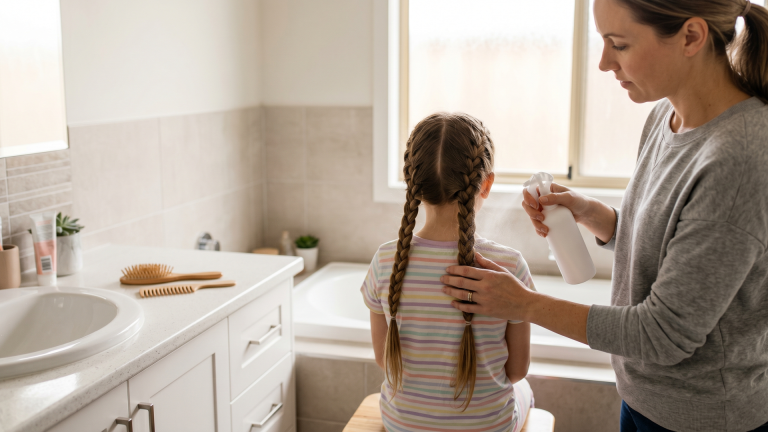
You can’t control what happens in the classroom, but you can reduce the opportunities lice have to reach your child’s head. Long hair should be pulled back in braids or buns every school day during an outbreak — loose hair creates more surface area for a stray louse to grab onto during the normal jostling of elementary school life.
Prevention Strategies for the Classroom and Beyond
Daily prevention during a school outbreak doesn’t have to be complicated or time-consuming. A consistent two-minute routine before school can significantly reduce your child’s exposure. At Lice Lifters of Nassau County, we recommend a combination of deterrent products and simple habit changes that together create multiple layers of protection.
- Apply a mint-based lice deterrent spray to your child’s hair every morning — the scent creates an environment lice actively avoid
- Teach your child not to share hats, headbands, hair ties, brushes, headphones, or pillows at school
- Keep jackets and hats in your child’s backpack rather than hanging them on shared coat hooks or tossing them in communal bins
- Do a quick two-minute head check every evening during an active outbreak — focus behind the ears and at the nape of the neck where lice prefer to lay eggs
Parents in Hicksville, Massapequa, Wantagh, and across Nassau County who build these habits into their routine during outbreak periods catch cases early — often before a single egg has been laid. Early detection is the difference between a quick professional visit and a week-long ordeal of home treatment attempts.
FAQs
Can my child be sent home from school immediately for having lice?
It depends on the district. Schools that follow AAP and CDC guidelines typically allow children with lice to finish the school day and begin treatment at home that evening. Some schools may still send a child home the same day, so policies vary. If you’re unsure about your school’s policy, ask the school nurse directly.
Does my child need to be completely nit-free before returning to class?
Under current AAP and CDC recommendations, no. Nits that are more than a quarter inch from the scalp have either hatched already or are no longer viable, and their presence alone does not indicate an active infestation. However, school policies vary, and some schools may have their own nit-check requirements, so ask the school nurse. If your school requires a re-check, professional treatment at Lice Lifters ensures that both live lice and nits are removed.
Should I tell other parents if my child has lice?
Yes, and it’s one of the most impactful things you can do to slow an outbreak. Notify the parents of your child’s close friends, sleepover partners, and anyone your child has had recent head-to-head contact with. Most parents appreciate the heads-up and will screen their own children, which catches cases early and prevents the outbreak from spreading further. Lice carry no stigma worth protecting at the cost of another family’s peace of mind — the sooner everyone knows, the sooner the cycle breaks.
How often do Nassau County schools screen for lice?
Screening practices vary by school and district, so ask the school nurse what your school does. You can ask the school nurse about a screening, or bring your family to Lice Lifters of Nassau County for a professional head check.
What documentation does my child need to return to school after lice treatment?
Requirements vary by school and district, so ask the school nurse what your school needs. Some schools may accept a parent’s written statement, while others may ask for a note from a healthcare provider or professional lice treatment service. According to the AAP, schools should allow children to return to class immediately after appropriate treatment.
If the school nurse has called and you need your child treated and cleared before tomorrow morning, book an appointment at Lice Lifters of Nassau County. Our Wantagh clinic offers same-day and next-day availability during the school year, and families across Nassau County — from Garden City and Levittown to Freeport and Hempstead — trust us to get their kids back to class lice-free in a single visit.