Spend the first 24 hours on three things: confirm that a live, crawling louse is really there, check every head in the house, and call your child’s doctor before you open any lice medicine. The CDC says finding a live nymph or adult louse on the scalp or hair is the best way to diagnose a case, and the AAP says lice medicine should be used only when it is certain your child has living head lice. The cleaning can wait its turn.
Hour One: Make Sure It Is Really Lice
Look for something crawling, not only for specks. The CDC says misdiagnosis of head lice is “common,” and that nits get confused with dandruff, hair spray droplets and dirt particles. The AAP gives the test that settles it: nits are firmly attached to the hair, while dandruff, dirt and other particles are not.
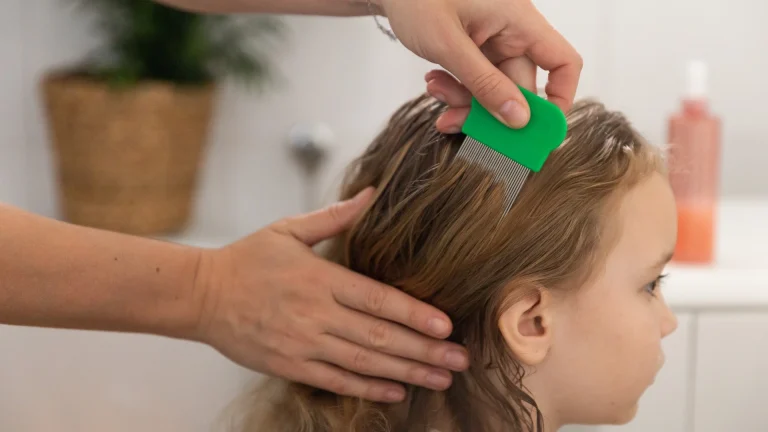
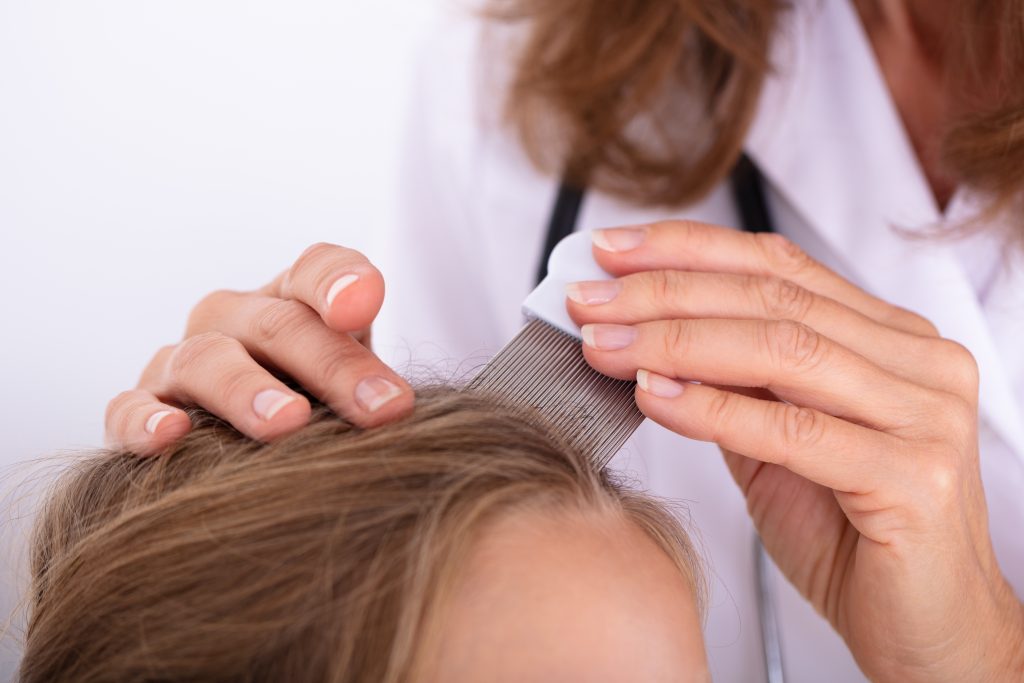
Seat your child in a brightly lit room and part the hair all the way down to the scalp in very small sections. Comb each section with a fine-tooth louse or nit comb, wipe the comb on a wet paper towel after every pass, then look carefully at the scalp, the comb and the towel. A magnifying lens may help. An adult louse runs about 2 to 3 mm long, roughly the size of a sesame seed, with a body that is usually pale and gray. A newly hatched nymph is closer to the size of a pinhead. Eggs are oval, about 0.8 mm long, usually yellow to white, and stuck fast to a hair near the scalp.
Start where they are easiest to find. The AAP puts that at the hairline at the back of the neck and behind the ears. Our post on where lice hide on the head goes further. They are hard to see because they avoid light and move fast, so take each section slowly. If you are unsure what you are looking at, the first signs of a head lice case are worth a read, and the CDC’s advice when you are not sure is to see your health care provider.
Does the Whole Household Need Treatment, or Only Whoever Has Live Lice?
Check everyone in the house, then treat the people who turn out to have live lice, together with anyone who shares a bed with them. That is the line the CDC draws: check all household members and other close contacts, and treat all infested persons and the people they share a bed with at the same time. The AAP says the same in fewer words, that household members and close contacts should be checked and treated if necessary. The CDC is also blunt that getting head lice is not related to the cleanliness of you or your environment, so a round of checks is a logistics job, not a verdict on your house.
Anyone can get head lice. The CDC estimates 6 to 12 million cases a year in the United States among children 3 to 11 years of age, and adults in the same household get checked for the same reason children do. What you find on each head decides what happens next.
| What you find on a head | What the CDC and the AAP say |
|---|---|
| A crawling nymph or adult louse on the scalp or hair | The CDC’s best way to diagnose a case. Treat it, and treat household members and close contacts who also have live lice at the same time. |
| Nits firmly attached within 1/4 inch of the scalp, no crawling lice | Where the CDC says to look when no crawling lice turn up. The AAP says eggs sit within 4 to 6 mm of the scalp and do not survive farther away. |
| Only nits more than 1/4 inch from the scalp | The CDC says the case is probably old and does not need treatment, and that nits that far out are almost always hatched or dead. |
If the only thing you can find is nits and no crawling louse, slow down before you treat. Nits without live lice can be the leftovers of a case that is already over, because empty nits stay on the hair shaft after the eggs hatch.
Call Your Child’s Doctor Before You Open Any Lice Medicine
Make that call before anything goes in the hair. The AAP says to check with your child’s doctor before beginning any head lice treatment, and that your pediatrician can help you choose an appropriate option; the CDC says to consult your health care provider before treating young children. Treatment comes as over-the-counter or prescription medicine, and the CDC’s treatment guidance says medications are generally safe and effective when used correctly. The AAP is candid that over-the-counter products “sometimes are not the most effective,” and that lice can be resistant to their active ingredients in some communities. Several prescription options are approved for children as young as six months, some need only one application, and some do not call for nit combing.
When you do treat, the label is the instruction manual, so follow the package directions exactly as written. An adult applies the medicine, never the child, and a child is never left alone with medicine in their hair. Skip conditioner and combination shampoo-conditioner before the medicine, rinse it out over a sink with warm water rather than hot, and leave the hair unwashed for a day or two afterward. Use one product at a time unless a provider tells you otherwise, keep it away from the eyes, and flush immediately if any gets in. It takes time to kill all the lice, so a few still moving slowly 8 to 12 hours later are not a reason to reapply.
The Shortcuts to Skip Tonight
The kitchen-cupboard remedies are unproven, and the harsh chemicals are dangerous. The AAP says not to use home remedies such as petroleum jelly, mayonnaise, tub margarine, essential oils or olive oil, because no studies prove they work, and the CDC says there is no scientific evidence that smothering lice with mayonnaise, olive oil, margarine, butter or similar substances treats them. Three more hard stops come straight from the AAP and the CDC:
- Never use gasoline or kerosene, or any medicine made for use on animals. Gasoline and kerosene are dangerous and flammable.
- Never place a plastic bag, or anything made of plastic, on a child’s head.
- Do not spray pesticides in your home, and do not use fumigant sprays or foggers. The CDC says they are not necessary to control head lice and can be toxic if inhaled or absorbed through the skin.
One more applies if your child’s doctor chooses malathion, which is flammable: the CDC says not to smoke or use electrical heat sources, including hair dryers, curlers and curling or flat irons, when applying it and while the hair is wet.
What Is Actually Worth Washing on Day One
Wash what touched the head in the two days before treatment, and stop there. That is the window the CDC names, and it adds that “spending much time and money on housecleaning activities is not necessary to avoid reinfestation.” A louse that falls off a person dies within two days because it cannot feed.
- Machine wash and dry the clothing, towels, bed linens and other items worn or used in the two days before treatment, using the hot water cycle at 130 degrees Fahrenheit and the high heat drying cycle.
- Seal anything you cannot wash in a plastic bag for two weeks, or have it dry-cleaned. You do not need to throw those items away.
- Soak combs and brushes in hot water, at least 130 degrees Fahrenheit, for 5 to 10 minutes.
- Vacuum the floor and the furniture where the person sat or lay.
For the rest of the house, a couple of habits are worth keeping. Keep combs, brushes and towels to one person each, along with hats, scarves, coats, hair ribbons and barrettes, and avoid hair-to-hair contact during play.
Frequently Asked Questions
How long does it take for the itching to start?
It can take four to six weeks for itching to appear the first time lice reach a scalp, says the CDC. The itch is an allergic reaction to louse bites, so a first or light case can arrive with no symptoms at all. The AAP adds that itching can linger for weeks after the lice are gone.
Can head lice jump from one head to another?
No. Head lice crawl, and the CDC says they cannot hop or fly. Spread happens through direct contact with the hair of someone who already has them, which the AAP describes as close, prolonged head-to-head contact. Shared combs, brushes, hats and sports helmets carry what the AAP calls a very small chance of passing lice along.
Could my child pick lice back up from the couch or a pillow?
That risk is very small. The CDC says the chance of getting lice from a louse that has fallen onto a rug, carpet or piece of furniture is very small, since lice cannot feed once they are off a person. The CDC does say not to lie on a bed, couch, pillow, carpet or stuffed animal that has recently been in contact with someone who has lice.
Do I have to get every last nit out?
No. Nits can stay in the hair after treatment, and the CDC says a successful treatment kills the crawling lice. Combing still earns its keep: the AAP suggests a comb-out every 2 to 3 days for 2 to 3 weeks to remove nits and eggs, while noting that the comb-out “usually doesn’t work on its own” to get rid of lice.
When is a second treatment the right call?
Only when you still see live, crawling lice. The CDC says to treat again only if there are live, crawling lice several days after treatment, and, for a medicine that kills lice but not eggs, about a week after the first treatment (7 to 9 days depending on the drug). Talk to your health care provider before re-treating, and do not treat the same person with the same medication more than 2 to 3 times if it is not working.
Can lice turn up in eyebrows or eyelashes?
Yes. The CDC says head lice live mainly on the head but can also be found on the eyebrows and eyelashes, and MedlinePlus says the same. If you think you see something along a lash line, read what head lice and nits on the eyelashes mean and ask your child’s doctor. Lice medicines have to be kept out of the eyes.
How Lice Lifters of Nassau County Can Help
If the sectioning and the second-guessing are more than you want to take on tonight, our clinic can do it instead. Lice Lifters of Nassau County checks the whole family in the same visit, which is what both the CDC and the AAP ask for, and our professional lice treatment is non-toxic and finished in one visit. Same-day appointments are available, and the 30 Day Guarantee applies when the whole family is checked. Bring your questions about what you found at home. When you are ready, book a head check and let us take it from here.